
Reviewed · GLASGOW TOURS
2.5 Hour Football Walking Tour in Glasgow
The striking idea here is that Glasgow’s football story is not confined to one stadium. This 2.5-hour walk links three Hampden Parks, an old recreation ground, a bowling club, an abandoned stadium, murals, and the modern national ground. You get a sense of how the sport grew rather than simply seeing where it is played today.
I like the focus on Queen’s Park’s role in shaping passing football, and I like that Cathkin Park still offers original terracing instead of a polished museum display. The main consideration is simple: this is an outdoor walking tour, not a stadium tour, so admission to Hampden Park is not included and poor weather can force a change of date.
Key points about the Glasgow football walk
- Three Hampden Parks in one route: Follow the grounds that carried the Hampden name from its earliest days to the current stadium.
- Football before the modern stadium: See Queen’s Park Recreation Ground and the Hampden Bowling Club, linked to the first Hampden Park.
- An abandoned ground with original terracing: Cathkin Park gives the walk its most atmospheric stop.
- Scottish football beyond famous scores: Hear about the sport’s birth, modernization, triumphs, and painful setbacks.
- A personal scale: The group is limited to 20 people, giving the guide room to explain details and answer questions.
- Straightforward cost and timing: The price is $33.94 per person, with a 10:30 am start and an end at Hampden Park.
Glasgow football begins at Queen’s Park
This tour starts at 16 Queen’s Drive, Glasgow, G42 8BS, near Queen’s Park Recreation Ground. That starting point matters. You are not being dropped beside a finished arena and handed a list of famous names. You begin close to the places where the game developed its early Scottish character.
The guide sets out the story of the passing and running game, a style shaped by Scots over many years and later enjoyed around the world. The point is not only that football began here in some broad sense. The walk explains how the grounds, clubs, and changing rules helped create the form of football you recognize today.
Queen’s Park Recreation Ground is described as part of the cradle of the modern game. For a football fan, that gives the opening section real weight. You can connect the sport’s tactics to a physical place, rather than treating football history as a string of dates and trophy results.
The setting also gives the guide a useful starting point for the wider story. Football has its successes, but it has also seen failure, loss, and change. The tour promises all three, so you should expect more than a victory parade.
More Walking Tours in Glasgow
- Glasgow City Centre Walking Tour with Local Guide
★ 5.0 · 1,326 reviews - Glasgow: Ghouls, Ghosts & Gruesome Tales Guided Walking Tour
★ 4.9 · 887 reviews - Glasgow: City Center Guided Walking Tour
★ 4.7 · 759 reviews
The first Hampden Park and the 1882 mural
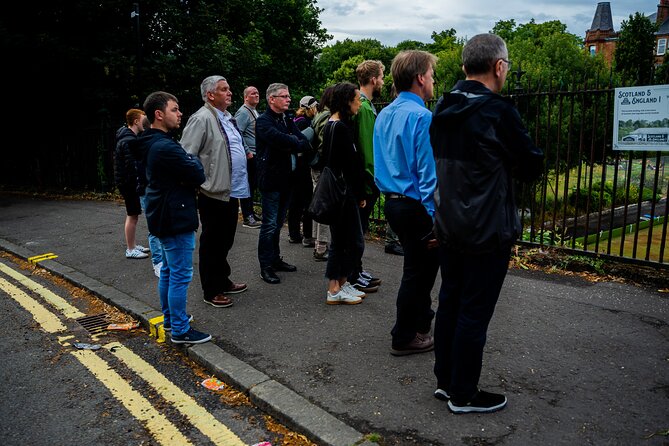
One of the unusual stops is the Hampden Bowling Club, identified with the first Hampden Park. It is a reminder that famous football grounds often begin in less grand surroundings. The name Hampden did not always mean a huge national stadium with major international matches. It belonged to a sequence of grounds that shaped the game over time.
At this stop, look for the first Hampden mural. It records Scotland’s 5 to 1 win over England on March 11, 1882. That score gives the story a lively human edge, but the mural also helps fix the history in place. You are not simply hearing that early football was important. You are standing near a visual marker tied to a specific international match.
I like this part of the route because it links local space to national pride without requiring a long museum visit. The mural is a quick, focused stop, yet it gives the guide a chance to explain how football became part of Scotland’s public identity.
Do not expect a large attraction with extensive indoor displays here. The value is in the guide’s interpretation and in seeing the setting for yourself. If you prefer stadium seating, changing rooms, and trophy cases, this may feel spare. If you enjoy the physical traces left by the past, it should be one of the more memorable moments.
Cathkin Park and the second Hampden
Cathkin Park is likely to be the most atmospheric stop. It is an abandoned stadium with original terracing, which gives you a rare look at football infrastructure after its main life has ended.
Modern stadiums are built to look finished. Cathkin Park shows something different. Its remaining terraces point to the scale and shape of an earlier football ground, while the abandonment adds a sober note to the tour. Football grounds can be celebrated, replaced, neglected, or forgotten. That is part of the sport’s story too.
The tour identifies Cathkin Park as the second Hampden Park. This makes the route easy to understand: the same famous name moved from one ground to another as football changed and facilities developed. You see the progression in the ground itself, not only in the guide’s explanation.
Bring sensible shoes and be ready for an outdoor stop. The supplied information does not specify the exact walking surface or condition of every section, so I would plan for ordinary city walking rather than assume a smooth, indoor route. Since the tour requires good weather, Cathkin Park is also a place where rain and poor conditions could affect the experience.
This is where the tour’s balance works well. You get the romance of football’s early years, but also a reminder that sporting history includes decline. That makes the walk more honest than a simple celebration of famous clubs and victories.
The third Hampden and the Rose Reilly mural
The final major stop is present-day Hampden Park on Letherby Drive, Glasgow, G42 9BA. This is where the walking story reaches the stadium most people will recognize as Hampden.
The route does not treat modern Hampden as the whole story. Instead, you arrive after seeing the earlier grounds, so the current stadium becomes the latest chapter in a chain of places. That change in order is useful. You understand the name Hampden as a living part of Glasgow football, not just as a single building.
The Rose Reilly mural adds another important detail. Rose Reilly is a major figure in Scottish football, and including her keeps the tour from presenting the sport as a story told only through men’s matches and famous male players. The mural offers a chance to consider the wider people and achievements connected with Scottish football.
Admission to Hampden Park is not included. This point deserves attention when you plan your day. The tour ends at the stadium, but the walking experience itself does not promise entry, an internal stadium visit, or a match-day atmosphere. If you want to see the inside, check separately for an available stadium experience or event, but do not count it as part of this booking.
Same country, a completely different kind of day out:
- Glasgow: Celtic Park Stadium Tour
★ 4.9 · 3,336 reviews - Guided Celtic Park Stadium Tour
★ 5.0 · 3,136 reviews - Glasgow: City Sightseeing Hop-On Hop-Off Bus Tour
★ 4.5 · 3,095 reviews - From Glasgow: Oban, Glencoe, Highland Lochs & Castles Tour
★ 4.9 · 2,123 reviews
What the guide adds to the two-hour route
The guide is the heart of this experience. The tour is built around stories of football’s birth, modernization, success, and failure, so a local guide does more than point toward old terraces. The best value comes from understanding why each place matters.
You can expect stories described as revolutionary and heartbreaking, along with the facts behind the grounds and murals. That range is important. A football walk should have energy, but it should not turn every stop into a victory speech. The strongest praise for this experience focuses on learning about Scotland’s connection to football, especially details that are easy to miss if you explore the area alone.
The walk is offered in English. The group can reach a maximum of 20 people, which is a sensible size for a route that depends on listening outdoors. A group of this size may still feel social, but it should give the guide more room to keep the story moving and respond to questions than a much larger outing.
No guide name is provided, so you should book this for the subject and format rather than for a particular named presenter. What is clear is that the tour uses a passionate local guide with strong knowledge of Glasgow football. That local focus is precisely what gives the route its appeal.
Is $33.94 good value?
At $33.94 per person, this is reasonably priced for a 2 to 2.5-hour guided walk, especially if you care about football history rather than only sightseeing. You are paying for a specialist story, a route through several meaningful sites, and local interpretation. You are not paying for transport, stadium admission, or an indoor exhibition.
That distinction helps you judge the cost fairly. If you simply want a photograph outside Hampden Park, the price is unnecessary. You can do that without a guide. If you want to understand why there are three Hampden Parks and how Glasgow helped shape the passing game, the fee makes more sense.
The tour also avoids the cost and time of private transportation because the route is walked. That means you should be comfortable spending much of the experience outdoors and moving between stops. The benefit is continuity: the city itself connects the story.
A five-star rating from the available feedback supports the tour’s educational appeal, with particular praise for learning about Scotland’s football connection. That praise matches the strongest feature of the route: it gives you context that is difficult to pick up from a stadium exterior alone.
Timing, meeting point, and practical planning
The stated start time is 10:30 am at 16 Queen’s Drive. The route ends at Hampden Park, so you finish at a major Glasgow football landmark rather than returning to the starting point.
The description refers to two hours with the guide, while the overall experience is listed as approximately 2.5 hours. I would allow the full 2.5 hours. That gives you a more comfortable margin for stops, explanations, and the walk between sites.
Because the route is outdoors and weather-dependent, check the forecast before setting out. If poor weather causes cancellation, you are offered another date or a full refund. The same applies if the minimum number of participants is not reached.
You can cancel for a full refund up to 24 hours before the start time. Changes or cancellations inside that 24-hour window are not accepted for a refund. Those rules are worth noting if your Glasgow schedule is still moving.
The tour is near public transportation, and service animals are allowed. Most people can take part, but the provided information does not give a precise distance, surface description, or accessibility assessment. If you have mobility concerns, ask the operator about the route before booking.
Who will get the most from this walk?
This is an easy choice for football fans who want more than a modern stadium visit. It suits you especially well if you enjoy old grounds, local stories, murals, and the way sports develop through time.
It can also work for visitors who know little about football. The strong focus on origins and change gives the guide a natural way to explain the game without assuming that you can name every club or player. One clear strength of the experience is that it promises to teach you something, not merely lead you from one photo stop to another.
Families and mixed-interest groups may find the walk useful if one person loves football and others want a local Glasgow story. The abandoned terrace at Cathkin Park and the murals provide physical points of interest, while the guide’s wider narrative gives non-specialists a reason to keep listening.
You may want to skip it if you need a fully indoor activity, want to enter Hampden Park, or prefer a short tour with little walking. The outing also depends on a minimum group size and suitable weather, so it is not as fixed as a museum visit.
The tour’s limits are part of the choice
The route is strong because it is specific. It follows the story of Hampden Park through three locations and gives the early game a real sense of place. That same focus means you should not expect a general tour of every football club, every Glasgow stadium, or every period of Scottish sporting history.
The lack of included transportation is not a serious problem if you are ready to walk, but it matters for planning. The tour starts at Queen’s Drive and ends at Hampden Park, so you should think about what you want to do after the final stop. The one-way format is useful if Hampden fits your later plans, less so if you need to return to the start.
The absence of included stadium admission keeps the price down, but it also limits what you see at modern Hampden. The tour’s real subject is the story around the grounds, not an interior stadium inspection.
Should you book the 2.5 Hour Football Walking Tour?
Book it if you want local football history with actual places attached to it. The three Hampden Parks, the 1882 mural, Cathkin Park’s original terracing, and the Rose Reilly mural give the route a clear identity. At $33.94, it offers good value for a specialist guided walk, provided you understand that admission and transport are separate.
Skip it if your priority is entering Hampden Park, staying indoors, or avoiding a weather-dependent activity. For football fans, curious first-time visitors, and anyone interested in how Glasgow helped shape the modern game, this is a focused and worthwhile way to spend a morning.
FAQ
Where does the football walking tour start?
The tour starts at 16 Queen’s Drive, Glasgow, G42 8BS, near Queen’s Park Recreation Ground.
Where does the tour end?
The tour ends at Hampden Park on Letherby Drive, Glasgow, G42 9BA.
What time does the tour begin?
The scheduled start time is 10:30 am.
How long does the experience last?
The experience is listed as approximately 2 hours 30 minutes. The walking-tour description refers to about two hours with the guide, so allow up to 2.5 hours.
Is the tour offered in English?
Yes. The tour is offered in English.
What locations are visited?
The route visits Queen’s Park Recreation Ground, the Hampden Bowling Club associated with the first Hampden Park, Cathkin Park associated with the second Hampden Park, and present-day Hampden Park.
Is admission to Hampden Park included?
No. Admission tickets are not included.
Is transportation provided?
No. Private transportation is not included. The experience is a walking tour.
How many people can join the tour?
The activity can have a maximum of 20 participants.
Can I cancel for a full refund?
Yes. You can cancel at least 24 hours before the local start time for a full refund. Cancellations or changes made less than 24 hours before the start time are not refunded or accepted.
What happens if the weather is poor?
The experience may be canceled because it requires good weather. You will then be offered a different date or a full refund.
Are service animals allowed?
Yes. Service animals are allowed.
Just added around Glasgow
- Balloch: Standing Stones, Castles & Highlands Tour★ 5.0 · 3 reviews
- 3 Day Isle of Skye Eilean Donan Castle and Loch Ness Tour★ 5.0 · 3 reviews
- Pints & Past: Glasgow Pub Tour Private Tour★ 5.0 · 3 reviews
- Glasgow: Glencoe & Oban Privately Guided Day Tour in Luxury MPV★ 5.0 · 3 reviews
- Jacobites and Scottish Highlands Day Tour from Glasgow★ 4.5 · 3 reviews
- Glasgow: Sample Fine & Rare Whiskies at Glengoyne Distillery★ 5.0 · 3 reviews
- The Scottish Highlands Photography Tour & Workshop★ 5.0 · 3 reviews
- Glasgow: Kentuck-Tea, A twist on afternoon tea★ 5.0 · 3 reviews
Glasgow Tours, compared.


City Sightseeing Glasgow Hop-On Hop-Off Bus Tour
Read our review →
Glenfinnan, Fort William, and Glencoe Day Trip
Read our review →

Loch Ness, Glencoe and Highlands Tour with Cruise
Read our review →
Browse the lists this tour appears in