
Reviewed · GLASGOW TOURS
Glasgow Private Self-Guided Tour
Glasgow’s story comes together on foot, from the medieval cathedral and grand tombs of the Necropolis to the city’s sharp, modern murals. This self-guided route gives you the freedom to pause for lunch, browse shops, or linger over a detail that catches your eye.
I like the excellent mix of old Glasgow and modern street art, and I like the low price of $12.37 per person. You also get three weeks of access, so you are not forced to finish in one sitting.
The catch is simple: this is an app tour, not a walking tour with a person. Some users found the map and audio controls awkward, with narration that did not always start on its own. Bring charged phones, headphones, and a little patience.
Key points before you set off
- Start at Glasgow Cathedral: The route opens with one of Glasgow’s most important medieval buildings and about 800 years of worship.
- Walk through the Necropolis: This 37-acre Victorian cemetery gives you broad city views and a memorable look at Glasgow’s wealthy past.
- Follow a strong mural route: St. Enoch, Smug’s woodland animals, and Honey, I Shrunk the Kids add a modern edge to the historic walk.
- Use your own timetable: The advertised route takes two to three hours, but you can stretch it to five hours with food, drinks, shopping, or museum stops.
- Expect audio guidance, not a live host: Alex provides the narration through the Pandemic Tours app, with photos, videos, directions, and GPS stops.
- Finish near St Enoch: The route ends at St Enoch Subway Station, close to the Roman Fort area and central Glasgow.
From Glasgow Cathedral into Glasgow’s earliest story
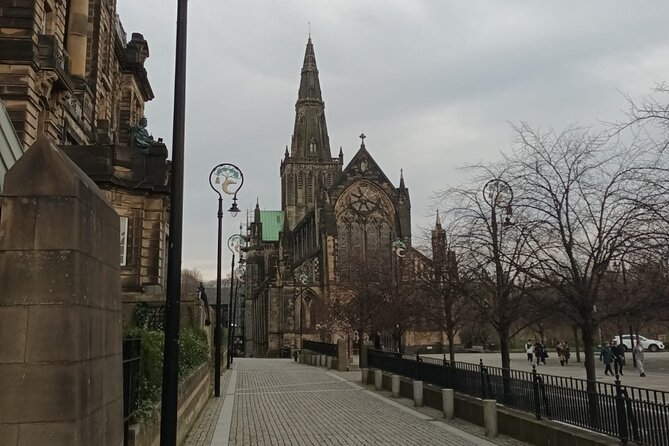
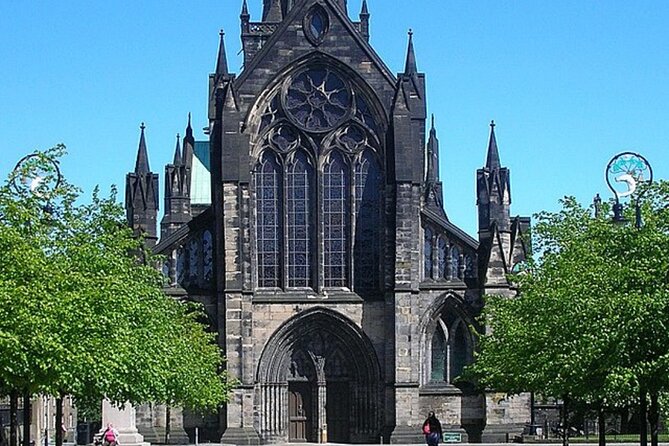
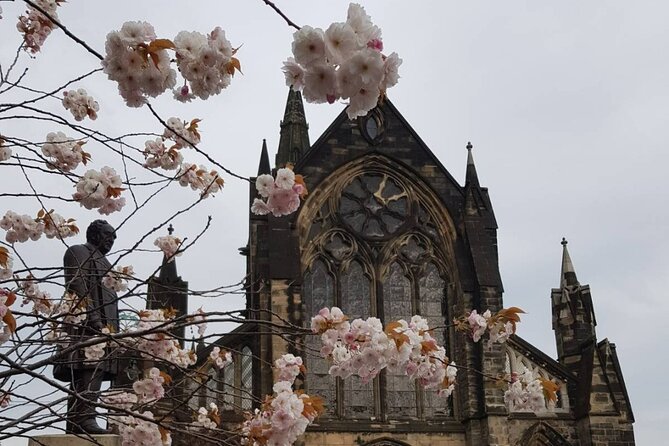
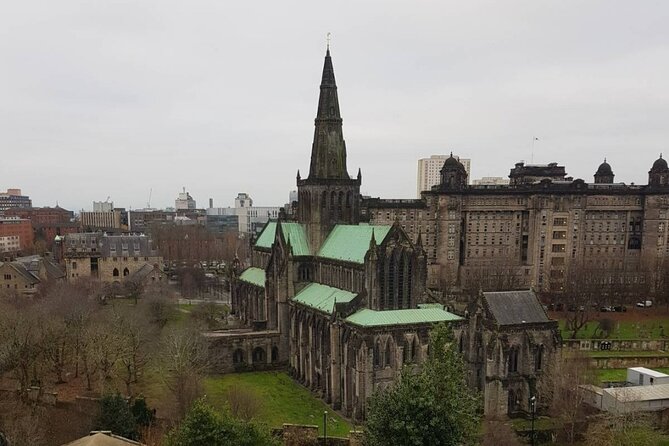
Begin on Castle Street beside Glasgow Cathedral. This is the strongest opening possible for a city walk because the building immediately gives you a sense of Glasgow before merchants, railways, shopping streets, and modern murals changed the city.
The present cathedral dates from 1197, after the first building was damaged by fire soon after its construction in 1136. Unlike many medieval churches, it has never lost its roof. Worship has continued inside its walls for more than 800 years.
Allow about 30 minutes here. The audio explains the cathedral and its setting, so you can look up from your phone and pay attention to the stonework. Admission to this stop is free, though the tour does not include entrance fees for attractions along the route.
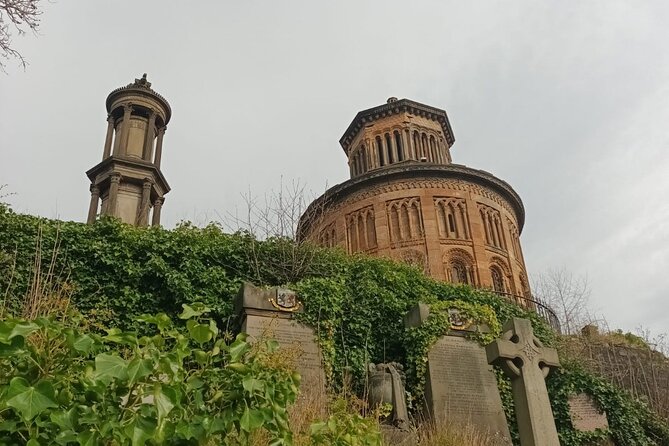
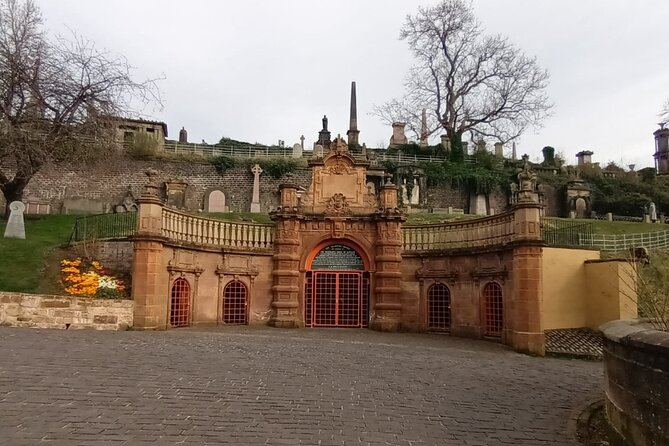
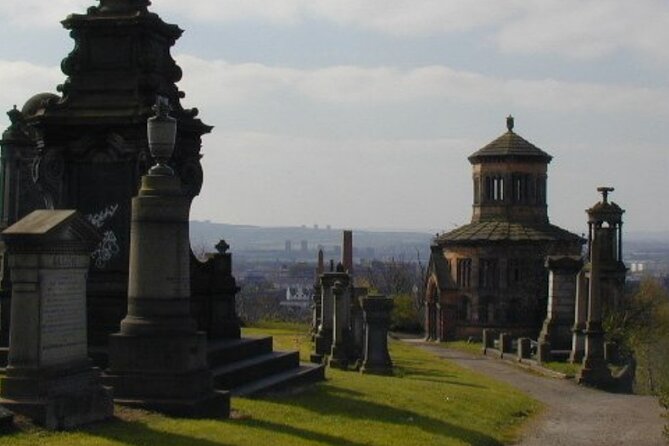
From the cathedral, you move toward the Glasgow Necropolis. The cemetery opened in 1831 and was modeled after Père Lachaise in Paris. Glasgow’s wealthy citizens wanted impressive memorials, and they certainly got them.
The Necropolis covers 37 acres, roughly the size of 15 soccer fields. The cemetery is not just a place for graves. It is a record of ambition, money, status, faith, and family pride. You will want more than the listed 15 minutes if you enjoy monuments or city views.
The short timing shown for the Necropolis is best treated as a minimum. The route may guide you through the main area, but you can pause when a monument or view catches your attention. Wear comfortable shoes, since this is an outdoor walking stop with uneven ground possible in a historic cemetery.
A few more Glasgow days to weigh up
- Glasgow Ghost Hunt: The Soul That Got Away Exploration Game
★ 4.0 · 71 reviews - Cycle To Loch Ness – Self Guided
★ 5.0 · 119 reviews - Harry Potter’s Edinburgh: A Self-Guided Audio Tour
★ 4.5 · 42 reviews
Provand’s Lordship and the old civic quarter
Next comes Provand’s Lordship, a stone building once known as the Hospital of St Nicholas. Its name changed over time, and the building gives the route another useful reminder: Glasgow’s oldest streets have been reused many times.
The stop descriptions also point you toward a building whose first official record dates to 1626. It served as the Town Clerk’s office, a justice court, the Town Council, and, at the top, a jail. The reason for placing the jail high in the building was security.
This section works best if you enjoy small pieces of city history rather than one grand sight after another. The app helps you notice buildings that are easy to pass without a second glance. That is one of the strengths of a self-guided route: you get a story for ordinary-looking places.
The University of Strathclyde follows, with around 15 minutes suggested for the stop. It is one of Glasgow’s three major universities, and the route points out its architecture and murals. The university section helps bridge the gap between old Glasgow and the city’s present-day student culture.
Murals that change the tone of the walk
Glasgow’s mural trail is one of the best reasons to choose this route instead of a standard old-town walk. Murals appear on neglected walls and gable ends, turning plain surfaces into public art and changing how people see street art in the city.
At the St Enoch Cradling St Mungo mural, a mother holds a baby in a futuristic version of the city’s patron saint. The image connects St Enoch with her son, St Mungo, and gives the local legends a modern form.
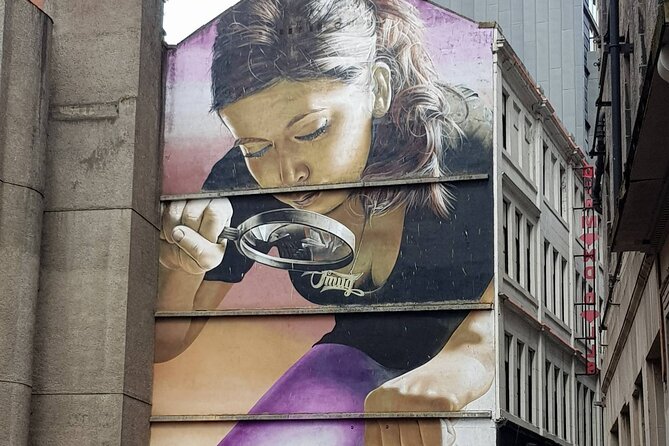
The route also includes Fellow Residents of Glasgow by Smug. A hiker gathers mushrooms in a woodland scene, while animals appear through openings in the wall. The animals shown can be found in Glasgow’s parks and green spaces.
The final Smug mural is Honey, I Shrunk the Kids, described as photo-realistic street art. These murals are more than quick photo stops. Together they show how Glasgow uses art to refresh overlooked parts of the city while still drawing on local identity.
The mural portions are short, but the route links them into a larger story. You see medieval saints, civic buildings, university walls, and contemporary art in the same walk. I would keep the app open long enough to hear the explanations before moving on, since the details give the artwork more meaning.
From Trongate to the Merchant City
The route then turns toward the older commercial streets. You pass the former Tron church tower, now connected with Tron Theatre, on Trongate. The street name comes from Saint Thenew’s Gait, a reference to the supposed burial place of Thenew, better known today as St Enoch.
That connection makes the St Enoch mural earlier in the route easier to understand. The tour keeps returning to the same local figures, so Glasgow’s legends do not feel like random names dropped into a script.
Another stop explains Glasgow’s early police force. Glasgow had the first police force in Great Britain, and a museum in the city presents its history from 1800 to 1975. The stop focuses on the people and events behind the creation and growth of the City of Glasgow police force.
You also pass a small statue of Mercury, the Roman god linked with commerce, travel, luck, trickery, and thieves. The sculpture is by Alexander Sandy Stoddart, and one of two Mercury statues marks the Italian quarter of the Merchant City.
This is a good stretch for anyone interested in how Glasgow made money. Tobacco merchants, trade, law, policing, and civic pride all enter the story. The city becomes less about medieval religion and more about business, movement, and public life.
Same country, a completely different kind of day out:
- Glasgow: Celtic Park Stadium Tour
★ 4.9 · 3,336 reviews - Guided Celtic Park Stadium Tour
★ 5.0 · 3,136 reviews - Glasgow: City Sightseeing Hop-On Hop-Off Bus Tour
★ 4.5 · 3,095 reviews - From Glasgow: Oban, Glencoe, Highland Lochs & Castles Tour
★ 4.9 · 2,123 reviews
98 Ingram Street and the old Ramshorn burial ground
At 98 Ingram Street, the route pauses at a church built in 1824 to replace an older building. English architect Thomas Rickman designed it in the Gothic Revival style.
The graveyard contains the burials of tobacco merchants Andrew Buchanan and John Glassford. Nearby, the older Ramshorn cemetery is partly covered by Ingram Street. In the eighteenth century, it was the fashionable and expensive place to be buried, before the Necropolis took over that role.
This short stop is easy to underestimate. The graveyard connects the city’s architecture with the merchants who helped shape Glasgow’s fortunes. It also gives you another look at how modern streets were built over earlier layers of the city.
Because the stop is listed at only five minutes, you may need to pause the narration if you want time to read plaques or examine the graves. That is a normal part of using this tour. The route provides the structure, but you control the pace.
George Square, City Chambers, and Glasgow’s public face
The City Chambers were completed in 1888 and opened by Queen Victoria. A statue of Victoria faces the building from the other end of George Square, creating one of the city center’s clearest civic scenes.
George Square takes its name from King George III. It was first planned in 1781 as part of a Georgian grid, though the square itself was not developed for another 20 years. The contrast between the planned square and the older, less orderly streets around it helps you read Glasgow’s growth.
This portion is useful if you have limited time in the city. It brings together government, royal imagery, urban planning, and public monuments in a compact area.
The route also points out one of Glasgow’s unusual emblems and explains the city’s sense of humor. The supplied details do not name the emblem, so you should rely on the audio for that explanation rather than expect a separate printed guide.
A major gallery appears nearby as another suggested stop. Again, the tour gives you the context, but any entrance charge is your responsibility. If you want to go inside, the planned two to three hours can quickly become a longer city outing.
Tea rooms, Buchanan Street, and modern Glasgow
One of the more distinctive stops is a tea room established in 1983. Its interior draws on the work of Charles Rennie Mackintosh, while the room itself is modeled after Kate Cranston’s Ingram Street tea rooms from the early 1900s.
This is a pleasant change of pace after churches, cemeteries, police history, and civic buildings. The stop explains the origin of the tea rooms, linking Glasgow’s modern design culture with the earlier work of Mackintosh and Cranston.
The route then reaches Buchanan Street, with about 10 minutes suggested. You have moved from the medieval cathedral through eighteenth and nineteenth-century commerce and into today’s central shopping district.
Buchanan Street is a useful finish because it shows Glasgow as it is now, not only as a collection of historic sights. You can pause for shopping, food, or a drink before continuing toward St Enoch.
The Lighthouse, a visitor center, exhibition space, and event venue in the heart of Glasgow, is another nearby point of interest. The route identifies it, but does not include admission. If you plan to visit any attraction, check your available time and budget before beginning.
How the app works in real use
After booking, you receive an email with instructions to activate the tour. Your booking reference is not the activation code, so read the instructions carefully. You must download the Pandemic Tours app to use the experience.
The package includes three weeks of unlimited access, a map, GPS route, directions, stop information, audio narration, photos, videos, and recommendations. Alex provides the recorded narration, and it is presented as a human voice rather than a computer-generated one.
The private format means only your group participates, but that does not mean a private guide will meet you. No live guide is included. You are responsible for following the route and starting the audio at each stop.
This distinction matters. One unhappy customer expected a person at the meeting point, while the tour is designed for independent use. Read the title and instructions closely before paying.
The app has a practical weakness. Audio may not start automatically, and navigation can require switching between the tour app and the map. One person found that the app sometimes lost its place after doing this. Another found the narrator’s volume low and the recording quality less clear than expected.
I would download the app and tour content before setting out, make sure your phone is well charged, and use headphones if you have them. Keep an eye on the map, but do not assume the app will guide you aloud from one stop to the next. The narration explains the sights, yet it may not continuously lead you along every connecting street.
Time, price, and who gets the best value
At $12.37 per person, this is inexpensive for a city introduction. The value comes from the amount of access rather than from a long list of included admissions. You get three weeks to use the route, and the app combines directions with historical context and visual material.
The stated duration is two to three hours. That works if you follow the stops without long breaks. If you enjoy photography, shopping, galleries, tea, lunch, or cemetery details, plan for much longer. One person took about five hours by stopping for food and drinks, which is exactly how this format is meant to work.
The route is best for solo visitors, couples, families with older children, and small groups who dislike fixed departure times. It is also useful if you want a first look at Glasgow before choosing which places deserve a longer visit.
It is less suitable if you want personal questions answered on the spot, a carefully managed walking pace, or a guide who handles navigation for you. The tour is also not ideal for anyone who expects entrance tickets to be covered. Attraction admission is not included.
The start is Glasgow Cathedral, Castle Street, Glasgow G4 0QZ. The finish is St Enoch Subway Station, Glasgow G1 4BW, near the Roman Fort area. Both ends are close to public transportation, and service animals are allowed. Most people can participate, though the route includes outdoor walking, streets, stairs, and cemetery paths, so choose footwear with care.
Should you book the Glasgow self-guided route?
Book it if you want a low-cost introduction that mixes Glasgow Cathedral, the Necropolis, Merchant City history, George Square, Buchanan Street, and some of the city’s best-known murals. The balance of medieval buildings and modern public art is the tour’s greatest strength.
Skip it if the thought of managing an app sounds tiring or if you are hoping for a live local guide. The audio content can be useful and detailed, but the controls may require attention, and some recordings may sound quiet.
My practical call: book it for flexibility and breadth, especially if you have only a few hours in Glasgow. Download everything before leaving, allow extra time, and treat the route as a framework rather than a race. At this price, it offers a smart way to get your bearings, provided you are comfortable being your own guide.
FAQ
Is this a guided walking tour with a live person?
No. This is a private self-guided activity for your group, with audio narration through the Pandemic Tours app. No live guide is included.
Who provides the audio narration?
Alex provides the audio guide. The tour includes a human narration rather than a computer-generated voice.
How long does the Glasgow tour take?
The suggested duration is about two to three hours. You can take longer if you stop for food, drinks, shopping, galleries, or extra time at the historic sites.
Where does the tour begin?
It begins at Glasgow Cathedral on Castle Street, Glasgow G4 0QZ, UK.
Where does the tour finish?
The route finishes at St Enoch Subway Station in central Glasgow, near the Roman Fort area.
What does the booking include?
You receive three weeks of unlimited access to the self-guided tour, plus the app route, map, GPS directions, stop information, audio, videos, photos, and recommendations.
Are attraction entrance fees included?
No. Any entrance fees for attractions mentioned along the route are not included in the tour price.
What do I need to use the tour?
You need to download the Pandemic Tours app after booking and follow the activation instructions sent by email. The booking reference is not the activation code.
Just added around Glasgow
- Private Harry Potter, Glenfinnan Viaduct, Highlands tour Glasgow★ 5.0 · 8 reviews
- Glasgow: Mountains, Glens & The Loch Ness Monster Day Tour★ 4.8 · 8 reviews
- From Glasgow: Castles, Clans & Outlander Day Tour★ 4.8 · 8 reviews
- Edinburgh Custom Private Walking Tour With A Guide (Private Tour)★ 4.5 · 8 reviews
- From Glasgow; Loch Lomond and Highlands Private Day Tour★ 5.0 · 9 reviews
- Loch Lomond, Inveraray and Argyll Private Tour from Glasgow★ 5.0 · 9 reviews
- Fun and Flexible Treasure Hunt Around Glasgow with Cryptic Clues★ 5.0 · 9 reviews
- Fun Glasgow City Centre Walking Tour Guided★ 5.0 · 9 reviews
Glasgow Tours, compared.


City Sightseeing Glasgow Hop-On Hop-Off Bus Tour
Read our review →
Glenfinnan, Fort William, and Glencoe Day Trip
Read our review →

Loch Ness, Glencoe and Highlands Tour with Cruise
Read our review →
Browse the lists this tour appears in