
Reviewed · GLASGOW TOURS
The Magnificent and Mysterious History of Glasgow
Glasgow’s past is not polished and tidy, and that is exactly what makes this walk appealing. In about two and a half hours, you move from grand civic buildings and proud statues to old markets, a notorious music hall, street murals, medieval streets, and the city’s great cathedral. The stories often have a scandalous or odd turn, which keeps this from feeling like a dry history lesson.
I like two things right away: the route gives you your bearings fast, and it packs much of central Glasgow into one outing. Guides such as Bruce and Henry Bell are praised for clear storytelling, humor, and local detail. The drawback is the pace and length. You cover a lot on foot, and a few people have found the stop-by-stop format less connected than they hoped. Construction or private services can also affect what you see.
Key points to know before you book
- George Square sets the story: City Chambers, war memorials, and statues introduce Glasgow’s civic pride and political past.
- The route covers Merchant City and the medieval core: You see grand commercial buildings, old markets, Trongate, High Street, and the cathedral district.
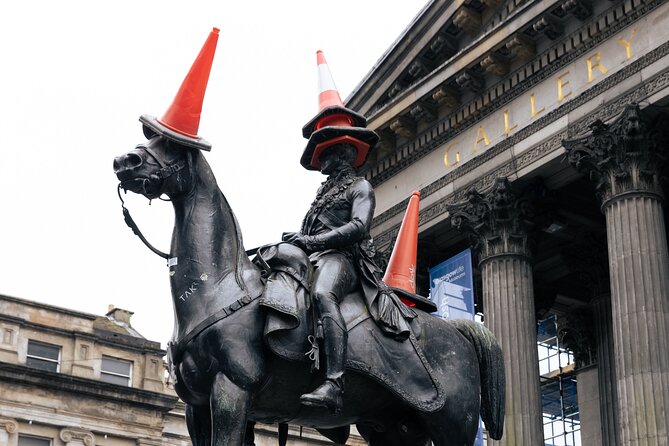
- Odd details are part of the fun: Look for the Duke of Wellington’s traffic cone, a pizza shop with an unusual past, and the world’s oldest surviving music hall.
- Bruce and Henry Bell are named guides: The guide may vary, but the strongest feedback centers on warm, lively, well-informed hosts.
- Plan for roughly 2.5 to 2.75 hours: The listing gives several duration figures, so leave extra time rather than scheduling a tight connection afterward.
- The group can reach 15 people: That keeps the price low, but you may need to stand close to hear every story.
George Square gives you Glasgow in miniature
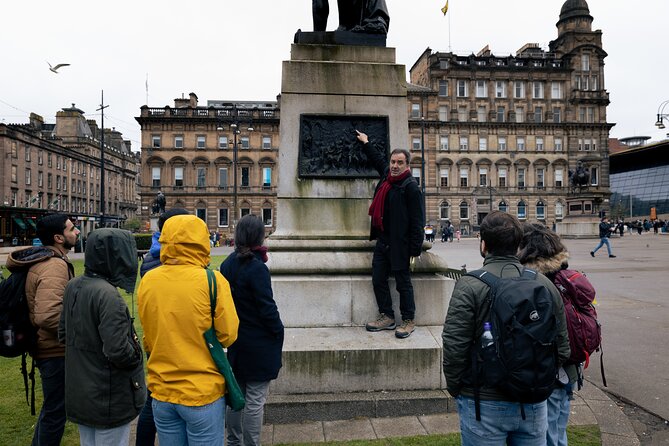
The walk begins at George House, beside George Square. This is a useful meeting point because the square gives you a quick visual lesson in how Glasgow wanted the world to see it: wealthy, civic-minded, literary, imperial, and confident.
The first major stop is the City Chambers, home of Glasgow City Council. It is described as one of the city’s most spectacular buildings, with sculpture that reveals how nineteenth-century Glaswegians viewed themselves. Allow about ten minutes here. You do not pay an admission fee, and the value comes from the guide’s explanation of the building’s symbols and public role.
The Glasgow War Memorial follows, with about four minutes devoted to the monument to citizens lost in the First World War. The stop is brief, but it helps mark a change in the city’s story. Glasgow’s nineteenth-century confidence could not remain untouched after the war.
In the same square, the Sir Walter Scott statue introduces one of Scotland’s most influential writers. The Robert Burns statue adds a more popular note. It was the first monument to Scotland’s national poet, funded partly by thousands of small contributions, including payments of just five pence. About 30,000 people attended its unveiling. That detail gives you a feel for Burns’s reach beyond elite literary circles.
A short recitation of a Burns poem is one of the memorable guide-led touches reported on this walk. If your guide has the same theatrical streak, the square becomes more than a collection of stone figures.
More history tours in Glasgow:
- Glasgow: The Magnificent and Mysterious History of Glasgow
★ 4.9 · 302 reviews - Glasgow: Historical Walking Tour: Guided by a local actor
★ 4.5 · 198 reviews - Glasgow: Pubs & History Walking Tour with Beer Tasting
★ 5.0 · 81 reviews
Merchants, mansions, and Glasgow’s money
From George Square, the route moves into the commercial center. Merchant’s House offers a look at the people who helped build Glasgow’s wealth and influence. The building suggests both their importance and the way they wished to present themselves.
The Gallery of Modern Art occupies what began as a private mansion. Its changing uses reflect the way central Glasgow’s buildings have been adapted over time. The tour does not function as a gallery visit, so you should not expect a long look at the collections. Instead, you get the building’s place in the city story and a useful exterior orientation.
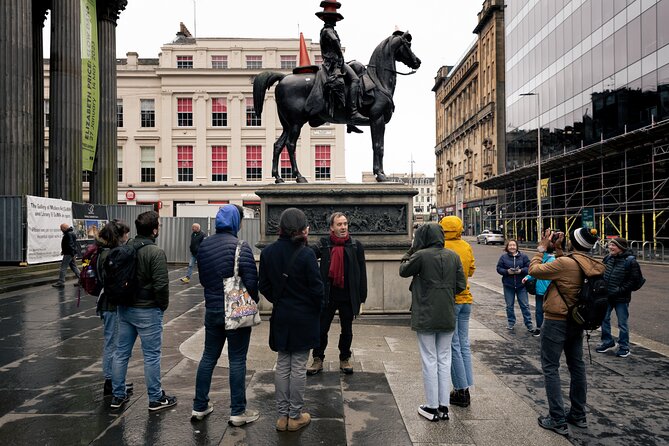
The Duke of Wellington statue is one of the tour’s easiest comic stops. Wellington was a decorated military leader and prime minister, but the statue is now best known for the traffic cone regularly placed on his head. The joke has become part of Glasgow’s public identity, with a touch of anti-authority humor.
Then comes Paesano Pizza, one of the city’s popular pizza spots. The stop lasts only a minute, but it hints at the tour’s style. You are not simply being led from famous monument to famous monument. You also get quick stories about ordinary businesses and unusual local associations, including a very particular job opportunity connected with the restaurant.
An eighteenth-century Georgian townhouse adds another layer. The original family’s story is described as interesting, though the stop receives little time. This is a good example of the route’s strength and weakness: you encounter many subjects, but some deserve more attention than the schedule allows.
Trades, markets, and Glasgow’s working life
The Trades Hall of Glasgow represents the city’s traditional trades, including carpenters, tanners, and dyers. It also reflects the practical side of urban society, looking after members who had grown too old to work.
That detail matters because Glasgow’s story is not only about merchants and grand civic buildings. It is also about systems of work, trade, support, and status. You get a glimpse of how different groups organized themselves and shaped public life.
The route then passes a medieval street associated with candle makers. They worked apart from the old town to reduce the danger of fire. Later, the area became a place for markets and warehouses, and it now forms part of Glasgow’s cultural district.
This is the sort of transition I like on a city walk. A street can carry several lives at once. The guide helps you see that what looks like a modern arts area may follow an older pattern of commerce and craft.
The Corinthian Club occupies another building with several past identities. It was once a bank, courthouse, and county building. Today it functions as a high-profile club and wedding venue. The stop gives you a chance to compare the seriousness of its earlier public uses with its present social role.
Merchant City’s religious and civic connections
The Saints of Ingram stop brings together Glasgow’s old charitable institutions. The Hutchenson’s Hospital, the original Merchants House, and the Trades House were once described as three graces of Glasgow. Together, they helped care for citizens over many years.
This is one of the places where the tour could make broader links between religion, business, charity, and civic power. The city’s wealthy groups did not simply build for show. They also created institutions that shaped daily life, though the walk gives only a short introduction.
The City Halls and Old Fruitmarket show a different side of commercial Glasgow. The fruit market was once a busy trading center. The building survives, though its use has changed, and you can still walk through it while imagining the noise and movement of its earlier days.
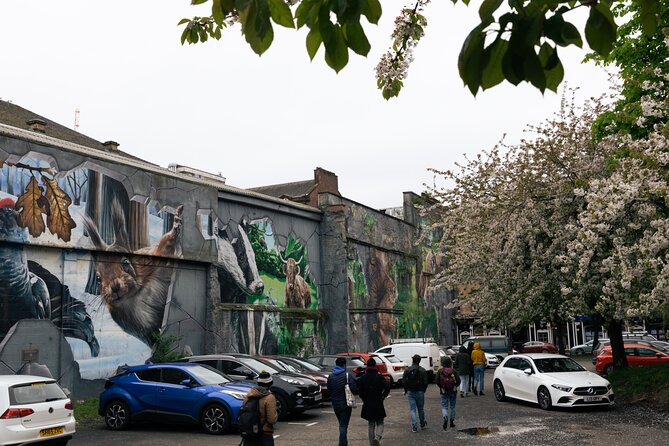
The route continues to Trongate 103, an arts center that includes the Sharmanka Kinetic Gallery. This section helps explain Glasgow’s artistic side without turning the walk into an art tour. You also pass popular street murals, including work linked to St. Mungo. Several guides make a point of these murals, and they add color and modern energy to a route otherwise heavy with stone, monuments, and old institutions.
A few more Glasgow days to weigh up
- Glasgow: Celtic Park Stadium Tour
★ 4.9 · 3,336 reviews - Guided Celtic Park Stadium Tour
★ 5.0 · 3,136 reviews - Glasgow: City Sightseeing Hop-On Hop-Off Bus Tour
★ 4.5 · 3,095 reviews - From Glasgow: Oban, Glencoe, Highland Lochs & Castles Tour
★ 4.9 · 2,123 reviews
The Britannia Panopticon and Glasgow’s stranger side
The Britannia Panopticon Music Hall is one of the tour’s most distinctive stops. It is described as the world’s oldest surviving music hall, and a young Stan Laurel performed there before becoming half of the famous comedy duo.
This is where the tour’s promise of a more scandalous Glasgow comes into focus. Music halls were places of entertainment and performance, but they also belonged to the rougher, less formal side of urban life. The short stop cannot cover everything, but it gives you a reason to return and explore the building in greater detail if it interests you.
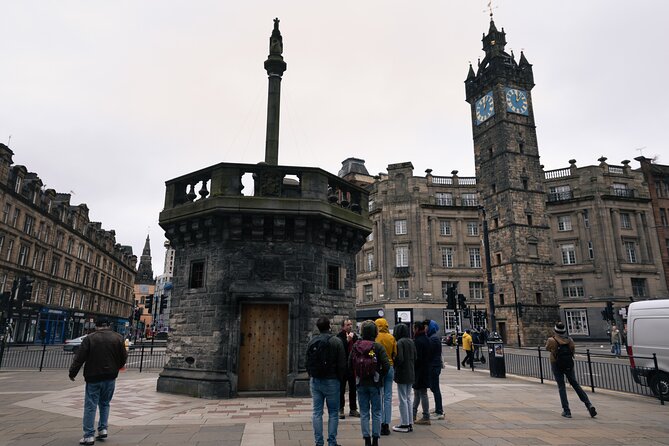
Mercat Cross follows. The current cross is a recreation of a medieval market cross, the place where proclamations were made. It helps you picture a time when public announcements were delivered in the street, not through phones or news websites.
These stops are particularly good for people who enjoy the small, quirky facts that make a city memorable. If you prefer long explanations of architecture at every stop, the quick pace may feel less satisfying.
High Street leads into medieval Glasgow
High Street was the heart of medieval Glasgow. The tour allows about fifteen minutes here, one of the longer outdoor sections, and that extra time is useful because several important sights are close together.
You hear about the site of the old university, described as the fourth oldest in Britain, as well as Glasgow’s patron saint, St. Mungo. Two murals connected with St. Mungo add a modern visual layer to an old religious story.
St. Mungo becomes a recurring figure on the walk. The cathedral district makes more sense once you understand his place in Glasgow’s origin story, and guides Bruce and Henry Bell have been singled out for explaining his miracles and significance in an accessible way.
The David Livingstone statue honors one of Scotland’s major explorers. It originally stood in George Square, so the statue also tells a small story about how Glasgow rearranges and reinterprets its public spaces.
At the Ramshorn Theatre, you see a building that opened in 1824 on the site of an earlier church. Many prominent Glaswegians were buried there. Its later life as a theatre, and its current use as a language studies center owned by the University of Strathclyde, provide another example of a building changing with the city.
Glasgow Cathedral is the serious finale
The Friends of Glasgow Royal Infirmary Museum stop points to Glasgow’s oldest hospital, where many medical innovations were pioneered. The stop is short, about three minutes, so consider it an introduction rather than a museum visit.
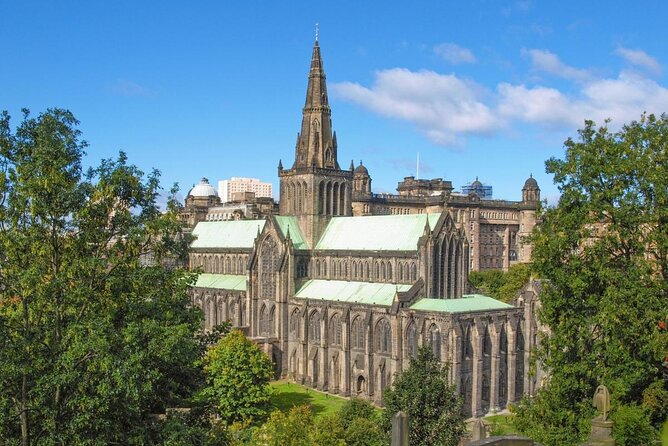
The tour’s major finale is Glasgow Cathedral. It is the oldest building in Glasgow, dating to the thirteenth century, with a church on the site since the sixth century. About twenty minutes are allotted here, which gives the cathedral more weight than most other stops.
The cathedral is where the city’s early religious story becomes visible. Its age, scale, and surviving structure make it a strong closing point after the statues, markets, civic buildings, and commercial institutions of the first half of the walk.
The route also includes Provand’s Lordship, one of Glasgow’s oldest buildings apart from the cathedral, dating to the fourteenth century. The St. Mungo Museum of Religious Life and Art completes the religious history theme. Its building was designed to look older, and its subject is the many religions practiced around the world today.
The published meeting information says the walk ends outside Ramshorn Church on Ingram Street, at 98 Ingram Street, not far from George Square. Since the final listed sights are in the cathedral and High Street area, confirm the exact finish with your guide on the day. Either way, you finish in a useful part of central Glasgow, with more city streets nearby to explore.
What the timing and group size mean
The advertised duration is inconsistent. One section gives roughly two hours and four to fourteen minutes, while the additional information says approximately two hours and forty-five minutes. The walking time between attractions is about forty to forty-five minutes, and the route includes more than twenty stops.
I would plan on at least two and a half hours, with spare time afterward. One account describes a quick but comfortable pace, while another found the tour ran about thirty minutes over schedule. That may depend on the guide, questions, construction, and how long the group spends at key sites.
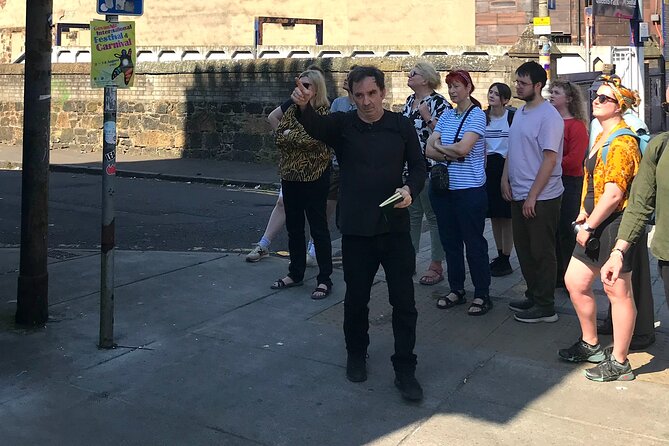
The group maximum is 15 people. That is still a modest number for a city walk, but it is not a private tour. One person found it hard to hear at times and would have preferred a smaller group. Stay near the guide, especially in noisy streets or open squares.
You receive a mobile ticket, and the tour is offered in English. It starts near public transportation, allows service animals, and is suitable for most people who can take part in a fairly long city walk. Wear shoes suited to pavement and check the forecast. The experience requires good weather, and poor weather can lead to a new date or a refund.
At $17.91 per person, the price is strong for a route of this length. You are paying for a guide who connects more than twenty sights, not for paid entry to museums or monuments. The value is best if you are new to Glasgow and want a framework for later exploring.
Who will get the most from this Glasgow walk
I would choose this tour early in a Glasgow stay. It gives you a map in your head, points out the Merchant City and medieval core, and helps you decide which places deserve a longer visit.
It suits you especially well if you enjoy:
- City architecture and changing building uses
- Local legends and slightly odd stories
- Scottish writers, saints, explorers, and public monuments
- Street art alongside older landmarks
- A brisk but manageable walking pace
- An introduction before independent sightseeing
It may not suit you if you want a quiet, highly focused architecture tour or a short introduction that finishes in George Square. The route covers a lot, and its broad sweep sometimes comes at the expense of a clear theme.
The strongest guides bring the material together. Bruce is repeatedly praised for humor, local recommendations, and stories that make Glasgow easier to understand. Henry Bell is described as clear, entertaining, and well prepared. Guide quality can vary, but the experience clearly depends on a host who can connect the stops rather than simply name them.
Should you book The Magnificent and Mysterious History of Glasgow?
Book it if you want a broad, good-value introduction to central Glasgow with plenty of stories and odd details. The Duke’s traffic cone, Burns’s crowdfunded statue, the Panopticon, St. Mungo’s story, the old fruit market, and the cathedral give you a useful mix of high culture, working life, religion, and local humor.
Go in with realistic expectations. This is a long overview, not a series of full interior visits, and construction or private events may block access to some sights. Allow extra time, stay close enough to hear, and use the finish as a launch point for more exploring.
Free cancellation is available up to 24 hours before the start time. If weather or the minimum group size cancels the walk, you are offered another date or a full refund. At this price, I would book it near the beginning of your Glasgow visit, especially if you want help deciding what to see next.
FAQ
Where does the tour begin?
It begins at George House, 50 George Square, Glasgow G2 1EH, UK.
Where does the tour end?
The meeting information gives the end as 98 Ingram Street, Glasgow G1 1EX, outside Ramshorn Church and not far from George Square.
How long does the tour last?
The supplied details give different estimates, ranging from about two hours and four minutes to two hours and fourteen minutes, with additional information saying approximately two hours and forty-five minutes. Plan for roughly two and a half hours or more.
How much walking is involved?
There is walking between the main attractions, estimated at about forty to forty-five minutes, plus time spent at more than twenty stops.
Is admission to the sights included?
The listed stops have no admission charge. The experience is an outdoor city walk with looks at buildings, statues, streets, murals, and selected interiors when access is possible.
Is the tour offered in English?
Yes. The tour is offered in English and includes a mobile ticket.
How many people can join the tour?
The maximum group size is 15 people.
Can I cancel for a refund?
You can cancel at least 24 hours before the start time for a full refund. Changes or cancellations made less than 24 hours before the start time are not accepted for a refund.
Just added around Glasgow
- Private Harry Potter, Glenfinnan Viaduct, Highlands tour Glasgow★ 5.0 · 8 reviews
- Glasgow: Mountains, Glens & The Loch Ness Monster Day Tour★ 4.8 · 8 reviews
- From Glasgow: Castles, Clans & Outlander Day Tour★ 4.8 · 8 reviews
- Edinburgh Custom Private Walking Tour With A Guide (Private Tour)★ 4.5 · 8 reviews
- From Glasgow; Loch Lomond and Highlands Private Day Tour★ 5.0 · 9 reviews
- Loch Lomond, Inveraray and Argyll Private Tour from Glasgow★ 5.0 · 9 reviews
- Fun and Flexible Treasure Hunt Around Glasgow with Cryptic Clues★ 5.0 · 9 reviews
- Fun Glasgow City Centre Walking Tour Guided★ 5.0 · 9 reviews
Glasgow Tours, compared.

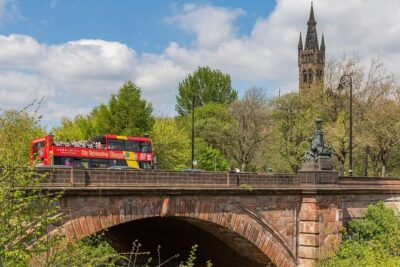
City Sightseeing Glasgow Hop-On Hop-Off Bus Tour
Read our review →
Glenfinnan, Fort William, and Glencoe Day Trip
Read our review →

Loch Ness, Glencoe and Highlands Tour with Cruise
Read our review →
Browse the lists this tour appears in